
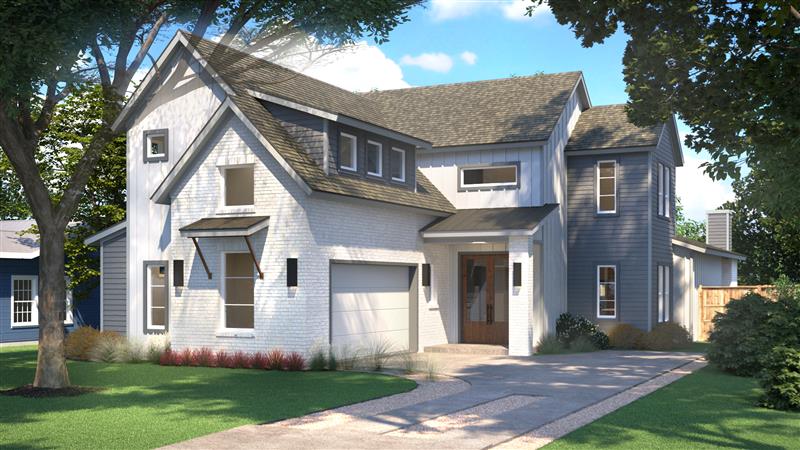
Infill and Density in Large Metro Areas by Dan Carlson, Birdsong’s Head of Architecture
We keep hearing the phrase “infill” these days, especially in larger cities like Houston, Dallas, and Austin. But what exactly does “infill” mean?
When high-population areas are more than 95% developed, housing availability becomes scarce and often cannot keep up with demand. In these cases, the land beneath an older home is often worth more than the home itself. This makes it appealing for developers to tear down the old structure and build a newer, larger, and more expensive one. The process of demolishing an existing project and redeveloping the property in these high-density areas is called “infill.”
Why does density come up in coversation so often?
Building single-family homes where single-family homes already exist doesn’t really solve density issues most cities face today. With limited land for apartment complexes, some cities are exploring ways to increase the number of dwelling units on single-family lots. For example, Austin recently passed an initiative allowing nearly all single-family properties to host up to three dwelling units.
Why not just build more apartment complexes?
While apartment complexes offer strong density solutions, they aren’t always feasible. First, in fully developed areas, it’s difficult to find large tracts of land for multifamily projects. Commercially zoned properties are usually already developed as commercial, and multifamily-zoned properties are already apartments. Second, strict zoning requirements or deed restrictions in some neighborhoods only allow single-family homes. Austin, for example, has enforced zoning ordinances since the 1940s, meaning about 95% of its land use is set in stone. That leaves cities to work with what they have.
Where are most of your home design projects?
I design homes all over central Texas, but when it comes to infill, most of my work is in Austin. Over the past 15 years, I’ve designed more than 300 homes in the city. Nearly all of them were subject to either the “McMansion ordinance” or the new “HOME ordinance.” Both offer ways to increase density.
McMansion vs. HOME ordinance: What’s the difference?
The “McMansion ordinance” (Subchapter F of the Residential Design Standards) was passed about 15 years ago to limit overdevelopment of single-family lots by restricting home size and massing. It also allowed accessory dwelling units (ADUs), often called granny flats, up to 1,100 square feet in size. I’ve designed well over 100 of these, and they’ve provided homeowners with rental income opportunities or housing for extended family.
In 2023, Austin passed the HOME ordinance—Home Options for Mobility and Equity. This allows infill lots to have up to three dwelling units and increases size limitations from 40% to 65% of the lot. On a typical 6,000-square-foot lot, that’s an increase from 2,400 to 3,900 square feet. However, the impervious cover limit remains at 45%, so reaching that maximum often requires going vertical—sometimes up to three stories.
Doesn’t this mean homes are smaller?
In many cases, yes. But trends over the past decade show buyers shifting away from 4,000+ square-foot homes with 5+ bedrooms in favor of smaller footprints. In the ’90s and early 2000s, most homes I designed were over 3,000 square feet. Today, the average is closer to 2,200–2,500 square feet, especially in infill areas. Many homeowners are willing to sacrifice size in order to live closer to downtown.
What are some common design elements of these smaller infill projects?
Because space is at a premium, we often use open floor plans where living and dining areas overlap for efficiency. Owner’s suites are more compact, typically with smaller bedrooms and shower-only bathrooms. With remote work becoming more common, pocket offices (compact workspaces) are popular alternatives to full-sized offices. Some projects have no covered parking at all but remain close to bus routes. When possible, we design for one-car garages, carports, or—on larger lots—a two-car garage. Ultimately, it’s about prioritizing what matters most to each homeowner.
Are people choosing duplexes and triplexes as housing options as well?
Yes, though they’re rarely a buyer’s first choice. Detached housing is far more desirable, and buyers will pay more for it. If a lot can accommodate two or three separate units, we aim for that approach. Even with small yards, buyers prefer the independence of detached living over sharing a wall with neighbors.
What makes this sort of design challenging?
Several things. First, Austin’s codes are some of the most complex in the country. It took me about five years to regularly pass plan reviews on the first submission. The city has produced a staggering number of memos clarifying the code. Second, clients new to the process are often surprised or frustrated by limitations. Many are shocked to learn that after paying $600,000 for a lot, they may only be allowed to build a 2,500-square-foot home. Finally, once those limits are established, fitting in all the client’s desired features can be difficult.
How does all this impact parking cars in the infill areas?
Before fall 2023, the city required at least two parking spaces per single-family project and four for duplexes. But in late 2023, Austin removed minimum off-street parking requirements. Now, theoretically, you could build three units with a total of 12 bedrooms and provide zero parking spaces.
Won’t this overcrowd streets?
So far, the market seems to self-correct. Projects without designated parking are harder to sell or rent, so most still include parking. In fact, of the six three-unit projects I designed last year, all included at least one parking space per unit. Parking demand has also declined in the past decade thanks to expanded public transit and more people working from home.
What is the future of infill?
Infill development thrives where three conditions exist: a strong economy, population growth, and limited undeveloped land. While many European and Asian cities rely heavily on apartments, single-family homes remain a cornerstone of the American dream. With more than 30 U.S. metro areas exceeding 2 million people, infill development will continue to play a critical role for decades to come.
Ready to Design Your Austin Infill Home?
At Birdsong Design Group, we specialize in custom home design across Central Texas, with deep experience in Austin’s infill housing market. Whether you’re planning an ADU, a multi-unit build under the HOME ordinance, or a custom single-family residence, our team can help bring your vision to life.
👉 Contact us today to schedule a consultation and explore your options.